
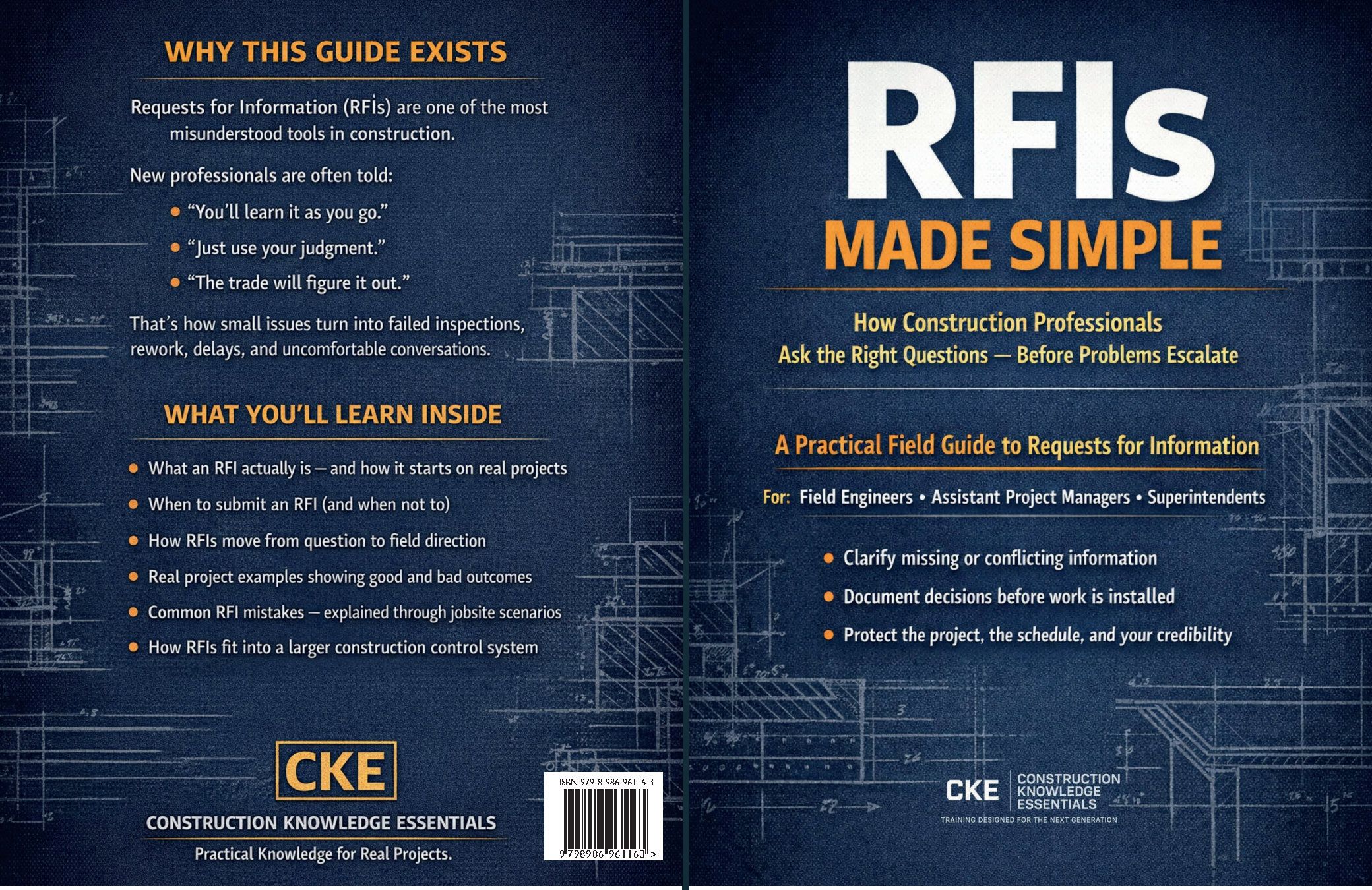
RFIs MADE SIMPLE
How Construction Professionals
Ask the Right Questions - Before Problems Escalate
Stop Letting Questions Turn Into Delays, Change Orders, and Blame
Every construction project runs on information.
When that information is unclear, incomplete, or misunderstood, the Request for Information becomes the pressure valve.
Handled poorly, RFIs:
-
Slow the schedule
-
Create tension between field and office
-
Open the door to scope gaps
-
Turn into costly change orders
-
Damage credibility
Handled correctly, RFIs:
-
Protect the job
-
Clarify responsibility
-
Prevent rework
-
Preserve relationships
-
Create documentation that defends your position
This guide shows you how to do it correctly.
This Is Not a “What Is an RFI” Book
This is not theory.
This is not textbook language.
This is site-pressure tested structure.
Inside RFIs Made Simple, you will learn:
-
When an issue truly requires an RFI and when it does not
-
How to write RFIs that get answered quickly
-
How to avoid vague, emotional, or dangerous wording
-
How to protect yourself through clean documentation
-
How to track RFIs so they don’t silently derail your schedule
-
How PMs, APMs, Supers, and Field Engineers should think differently about them
If you’ve ever:
-
Sent an RFI and waited weeks for an answer
-
Received a useless response
-
Watched work stop because clarification was late
-
Been blamed for “not asking sooner”
-
Or had scope creep disguised as confusion
This guide is for you.
Who This Is For
-
Field Engineers who want to operate above entry level
-
Assistant Project Managers who want to reduce risk, not just push paper
-
Superintendents who need clarity before work starts
-
Project Managers who are tired of drift
-
Small contractors who can’t afford documentation mistakes
If you are serious about becoming trusted in this industry, you must understand how information moves.
RFIs are not paperwork.
They are leverage.
Why This Matters
Most project failures are not dramatic.
They develop quietly.
A detail unclear.
A dimension not verified.
A spec interpreted differently in the field.
A question that should have been formalized — but wasn’t.
Then months later:
-
Schedule slips
-
Relationships strain
-
Costs climb
-
People start defending positions
Clear RFIs early are cheaper than arguments late.
This guide teaches that discipline.
What You’ll Walk Away With
After reading this, you will:
-
Write cleaner, tighter RFIs
-
Understand risk exposure before it becomes visible
-
Communicate with less emotion and more structure
-
Gain credibility with architects and engineers
-
Protect your company’s position professionally
And most importantly,
you will stop treating RFIs as clerical tasks —
and start using them as a control tool.
Ready to Get Access?
CKE Membership (All Access) gives you entry to the full Construction Knowledge Essentials system, including resources for:
- Field Engineers
- Foremen
- Assistant Superintendents
- Superintendents
- Assistant Project Managers
- Project Managers
- Construction Blueprints Reading & Coordination
All built around real jobsite responsibility.
Get CKE Membership (All-Access)